
June 29, 2026
In this post: The soil problem hiding in commercial compost, How anaerobic digestion captures nutrients and mitigates contaminants, Keeping nutrients local, What this means for farmers and regulators, For farmers, For regulators, Learn more about Divert’s approach to soil health
Summary: Commercial food waste contains packaging that standard composting systems often fail to remove through manual source separation, and shred into smaller particles that cannot be removed by their own screening processes, leaving plastic contamination in the finished compost that ends up on farmland. Divert’s process gently separates organics and packaging, sending the organics through advanced contaminant screening to return a cleaner, nutrient-rich digestate to farms near its facilities.
The soil problem hiding in commercial compost
Farmers and agricultural regulators have long treated compost as a net positive for soil health. It adds organic matter, feeds microbial communities, and reduces dependence on synthetic inputs. Those benefits are real. But commercial compost made from packaged food waste carries a contaminant that most operators don’t measure and most buyers don’t ask about: plastics.
Plastic contamination enters the composting stream through the packaging that surrounds commercial food such as poly bags, cucumber shrink wrap and produce stickers.
Research published in the Journal of Hazardous Materials in 2025 found that the composting process itself, which relies on shredding to encourage decomposition, increases microplastic abundance and shifts the particle size distribution toward smaller, harder-to-detect fragments, meaning the finished product that reaches a farm field can carry a higher microplastic load than the feedstock that went in.1
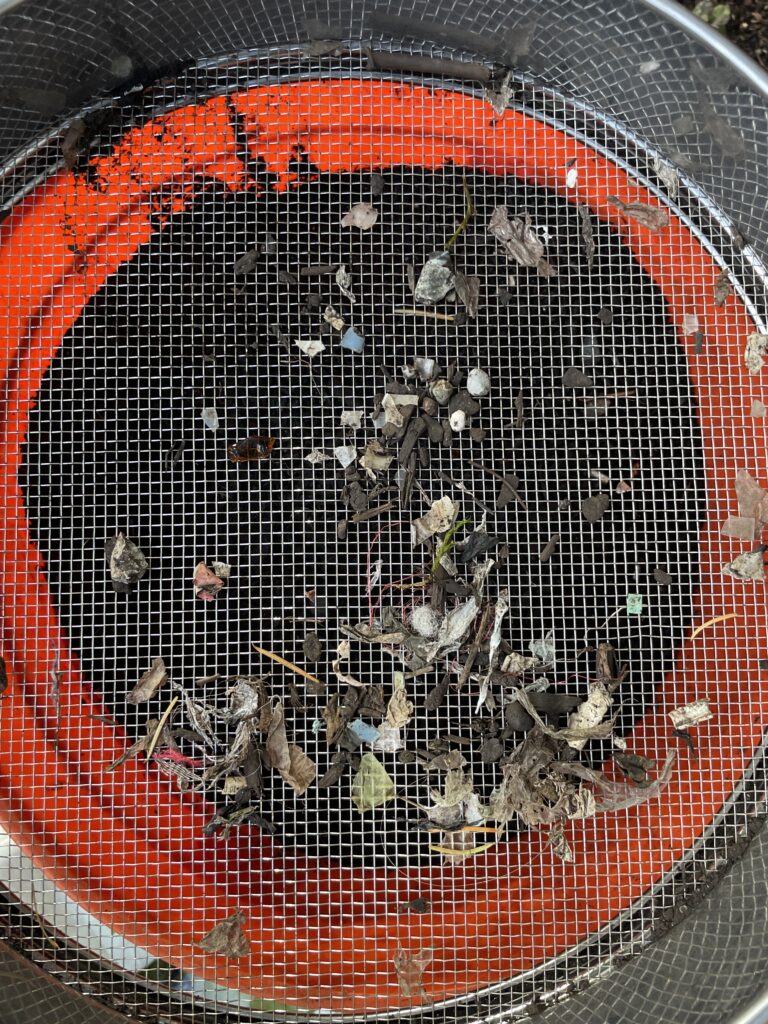
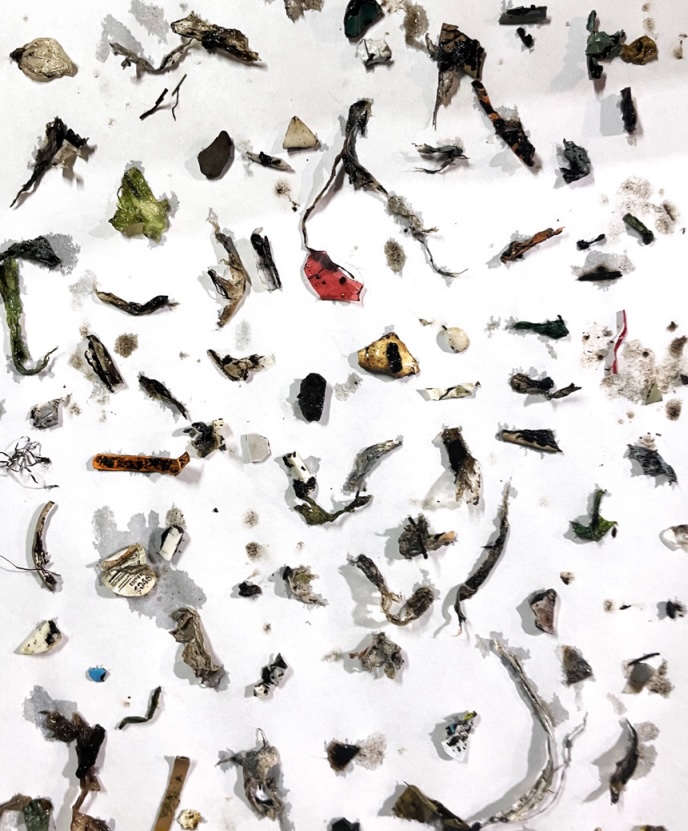
Plastic contamination of any size is a problem. Recent third-party testing of commercially available compost in Washington State found physical contamination six times greater than the state’s allowable plastics limit.2 Additional physical sift screen testing found physical contaminant levels amounting to approximately 1 cup of contaminants from each 1 cubic foot bag of finished compost. Land applying this compost across a typical 445-acre farm would be the equivalent of micro-landfilling farmland with 240 cubic yards of contaminants – or six 40-yard dumpsters full of plastic contaminants.3
The consequences for soil are not cosmetic. Greater volumes of plastics in agricultural soil disrupt nitrogen and carbon cycles, alter microbial communities, and can inhibit seed germination and nutrient uptake in crops.4 These are the biological systems that determine whether a field is productive.
Commercial food waste arrives heavily packaged in plastic film, rigid containers, and composite materials, and in volumes that make manual separation impractical. How that material is handled through any diversion pathway determines how much plastic contamination carries through to the finished output.
How anaerobic digestion captures nutrients and mitigates contaminants
The nutrients locked in commercial food waste don’t disappear because a product couldn’t be sold. The challenge is finding a pathway that recovers those nutrients without delivering excessive plastic contamination along with them.
Anaerobic digestion is a biological process in which microorganisms break down organic material in the absence of oxygen. Among its outputs are digestate – the nutrient-rich solid and liquid material that remains after digestion is complete. Digestate from food-based feedstocks typically contains 1.5 to 6.2 grams of total nitrogen per kilogram, along with retained phosphorus and potassium.5 Peer-reviewed data shows digestate improves soil structure, supports moisture retention, and stimulates microbial activity when applied to farmland.6
Anaerobic digestion on its own does not automatically solve the contamination problem, though. What goes into the digester determines what comes out. This is where Divert’s process diverges from standard practice.
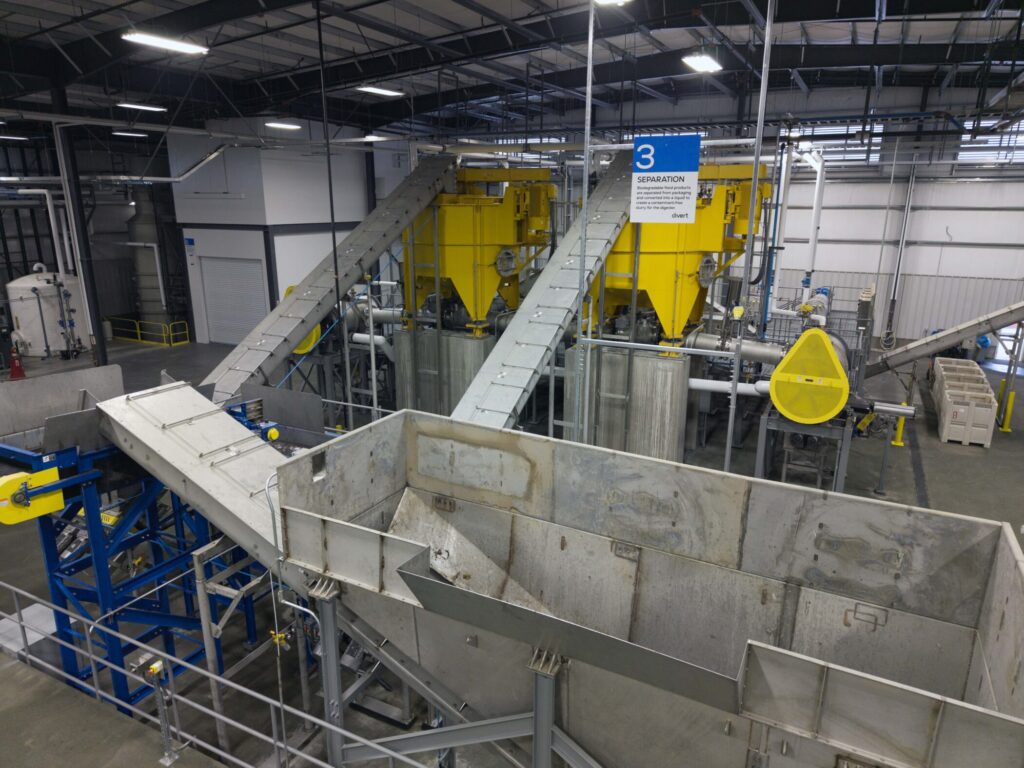
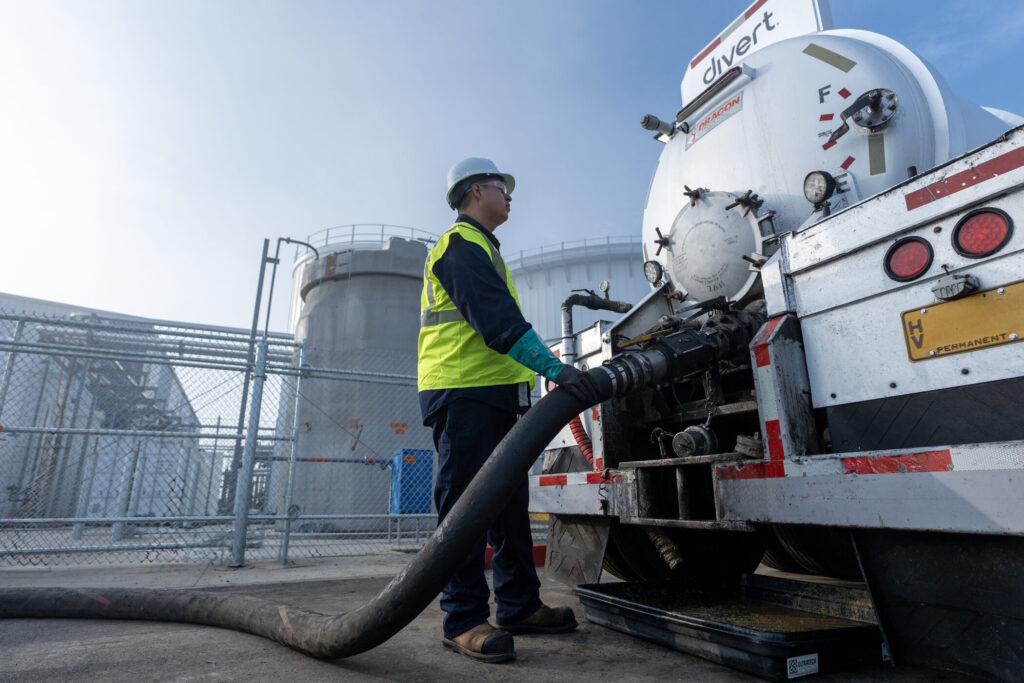
Divert’s High-Recovery Depackaging is a custom-engineered system that maximizes organics recovery and minimizes inorganic contamination in two steps. First, by separating organics from outer packaging without shredding or pulverizing the incoming material, macro-plastics are removed rather than being shredded into smaller pieces. Once separated, the organics pass through a fine liquid screening process using multiple mesh screen steps to mitigate incidental remaining contaminants. Off-the-shelf depackaging systems typically shred or pulverize incoming packaged food and rely on dry screening, which lacks the resolution to capture finer particles.7
Divert’s screening fidelity is finer than all current state regulatory thresholds for physical contaminants by particle size, while screening fidelity for common off-the-shelf depackaging and composting equipment often fail to meet these same regulatory thresholds.8 In third-party physical contamination testing, Divert’s digestate-derived products outperformed comparable compost products, with physical contaminant tests showing a 0.0% contamination rate.2
Because plastic is removed at the outset and the filtering steps for incidental contamination are high fidelity, what reaches the digester is food, and what exits as digestate reflects that: a nutrient profile drawn from the food itself, not from the packaging it arrived in.
Divert is also able to recover nitrogen in a liquid form after digestion, offsetting reliance on synthetic fertilizers. Divert’s solid and liquid digestate from clean food-based feedstock supplies necessary micronutrients and rebuilds organic microbial diversity, all while reducing a farm’s exposure to the plastic accumulation that repeated compost application can produce over time.
Keeping nutrients local
Recovering nutrients cleanly is one part of the equation. Where those nutrients go next is the other.
Digestate transported hundreds of miles to reach farmland trades one inefficiency for another. Transport adds cost and emissions, and it severs the connection between the supply chain generating the unsaleable food and the agricultural land that could benefit from it. A circular system works best when the loop is short.
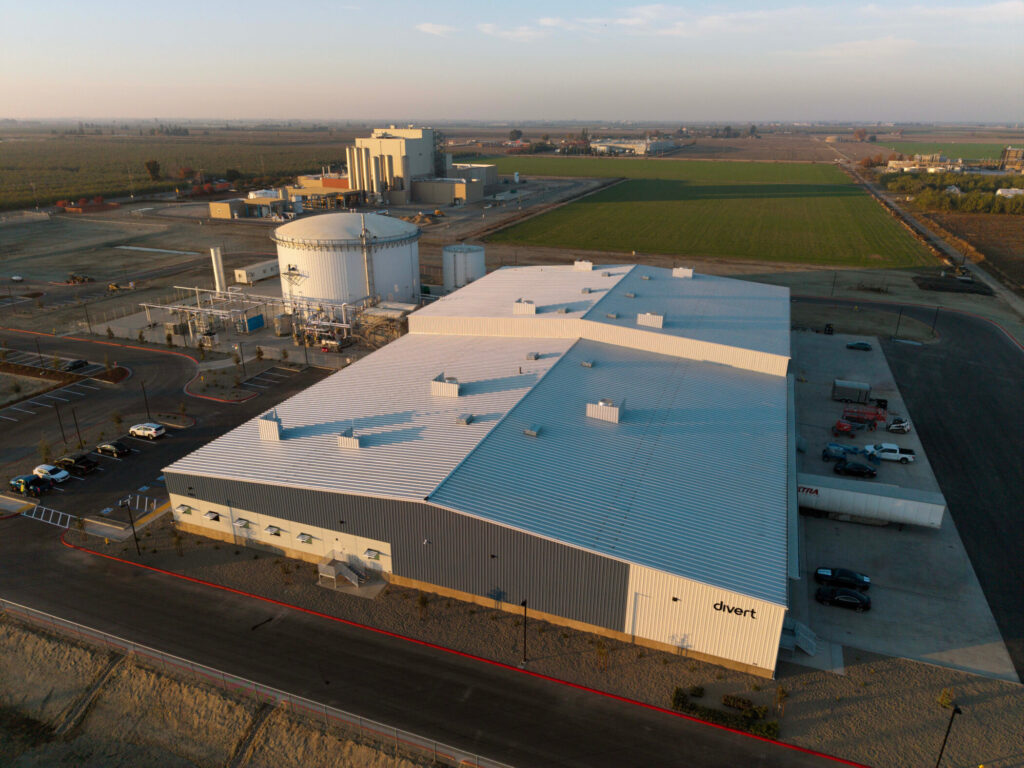
Nutrients extracted from food that moved through regional supply chains should return to regional farmland as fertilizer and soil amendment. Agricultural operations close to a Divert facility – such as Western Milling and Créeme Brulee Farm Co. in California – receive fertilizers produced from food grown or distributed within the same area. That geographic alignment matters for several reasons. Shorter haul distances reduce the carbon footprint of the amendment itself. Farmers and agronomists can build an ongoing relationship with a consistent, documented input rather than sourcing compost from feedstocks with variable and often unknown contamination histories. For regulators tracking organic waste flows under state organics management laws, local digestate application is also easier to verify and document than long-distance material transfers.
Divert has processed more than 4.2 billion pounds of wasted food to date and is scaling infrastructure to expand nationally. As that network expands, more regional food systems gain access to a nutrient return pathway that avoids the emissions of landfill disposal and mitigates the plastic contaminant trade-off of conventional compost.
What this means for farmers and regulators
For farmers
Synthetic nitrogen fertilizer is effective at supplying macronutrients, but its production and use carries a significant emissions burden. A 2022 peer-reviewed study in Scientific Reports estimated that synthetic nitrogen fertilizer accounted for 1.13 billion metric tons of CO2-equivalent globally in 2018, roughly 10.6% of all agricultural emissions.10 Solid digestate and liquid fertilizer from food-based anaerobic digestion supplies the same core macronutrients while also contributing organic matter that synthetic inputs do not provide.
The agronomic effects go beyond the nutrient label. Digestate application improves soil structure, increases moisture retention, and stimulates microbial communities.11 These are the indicators that determine long-term field productivity and resilience to drought and compaction. An input that arrives from a feedstock filtered for plastic contaminants upstream is a meaningful distinction from compost products whose contamination history is often unverifiable.
Repeated applications of contamination-laden compost accumulate plastic load in the soil profile over seasons. Switching to a cleaner amendment does not undo prior contamination, but it stops adding to it.
For regulators
State organics management laws, including SB 1383 in California and HB 2301 in Washington, require commercial food waste generators to divert organic material from landfills and, in some cases, to document where that material goes. ReFED estimates that 23 million tons of surplus food still reached US landfills in 2024, generating over 600,000 metric tons of methane.12 The gap between current practice and compliance targets remains large.
Closing that gap requires a robust organics processing industry where composters and anaerobic digesters can manage feedstock best-suited for their operations under clear purity standards. Divert provides certificates of destruction, volume data, and ancillary documentation that support regulatory reporting. Digestate and fertilizer application to local farmland creates a verifiable end-use record: organic material is diverted from landfill, processed to mitigate plastic contaminant pass-through, and returned to agricultural land within the region.
Learn more about Divert’s approach to soil health
Divert works with food businesses across the supply chain to prevent wasted food, optimize donations, and convert non-donatable unsold food into renewable energy and fertilizers. If you manage farmland near a Divert facility, or oversee organic waste compliance for a food business, contact us today to learn how Divert can create value for your operation as a vertically integrated partner focused on advancing a truly circular food system.
- Zhang et al., “Composting treatment increases the risk of microplastics pollution in process and compost products,” Journal of Hazardous Materials, Vol. 486, March 2025.. https://www.sciencedirect.com/science/article/abs/pii/S0304389424036653 ↩︎
- Based on results from third-party testing by Soil Test Farm Consultants (Washington State Department of Ecology’s preferred third-party testing service)
– Sample of Divert’s digestate: 0.0% physical contaminants
– Sample purchased from the City of Seattle’s contracted compost provider: 1.41% physical contaminants, 40% above Ecology’s physical contaminant limit and six times greater than the state’s allowable plastics limit of 0.25%. ↩︎ - Sift screen testing of sample purchased from the City of Seattle’s contracted compost provider found approximately 1 cup of contaminants from each 1 cubic foot bag of finished compost. Land applying this compost across a typical 445-acre farm would be the equivalent of micro-landfilling farmland with 240 cubic yards of contaminants – or six 40-yard dumpsters full of plastic contaminants ↩︎
- Ziajahromi et al., “Microplastic uptake and impacts on crops under realistic exposure,” Environmental Science and Pollution Research, April 2026. https://pmc.ncbi.nlm.nih.gov/articles/PMC13095943/ ↩︎
- Tiong et al., “Enhancing sustainable crop cultivation: The impact of renewable soil amendments and digestate fertilizer,” Environmental Pollution, February 2024. https://www.sciencedirect.com/science/article/abs/pii/S0269749123021346 ↩︎
- ScienceDirect Topics, “Digestate — an overview.” https://www.sciencedirect.com/topics/agricultural-and-biological-sciences/digestate ↩︎
- Based on individual screen-pore area, Divert’s screening methods operate at higher fidelity, with pores approximately 26 times finer in area than one of the most used off-the-shelf depackaging and compost screening methods.
– Divert (2 mm round holes): π/4 × 2² = 0.785 × 4 = 3.14 mm²
– Trommel screening (9 mm square holes): 92 = 81 mm² ↩︎ - EPA (2021) Emerging Issues in Food Waste Management, Plastic Contamination, https://www.epa.gov/system/files/documents/2021-08/emerging-issues-in-food-waste-management-plastic-contamination.pdf
– Particle size limit for physical contaminants is 4 mm in MN, MD, OH, CA
– Divert (2 mm round holes)
– Trommel screening (9 mm square holes) ↩︎ - Based on results from third-party testing by Soil Test Farm Consultants (Washington State Department of Ecology’s preferred third-party testing service)
– Sample of Divert’s digestate: 0.0% physical contaminants
– Sample purchased from the City of Seattle’s contracted compost provider: 1.41% physical contaminants, 40% above Ecology’s physical contaminant limit and six times greater than the state’s allowable plastics limit of 0.25%. ↩︎ - Menegat et al., “Greenhouse gas emissions from global production and use of nitrogen synthetic fertilisers in agriculture,” Scientific Reports, August 2022. https://www.nature.com/articles/s41598-022-18773-w ↩︎
- ScienceDirect Topics, “Digestate — an overview.” https://www.sciencedirect.com/topics/agricultural-and-biological-sciences/digestate ↩︎
- ReFED, “Climate Change & Food Waste,” 2024. https://refed.org/food-waste/climate-and-resources/ ↩︎


